
Which Came First: Higher Education or Higher Income?
Date Published
Perhaps one of the most famous riddles of all time is the age-old question, “Which came first, the chicken or the egg?” The question was originally posed by Greek philosophers as a pondering on how life began. Plutarch, Middle Platonist philosopher, struggled to come up with a solution to this paradox in his essay Symposiacs. This week, we’ll be channeling our inner Plutarch to answer another age-old question: Is higher education required to be financially successful? In this article, StatisNostics is discussing whether or not education attainment influences the amount of money a person makes.
The U.S. Bureau of Labor Statistics has coined the phrase, “The more you learn, the more you earn.” The Bureau annually provides statistical data to support the claim that higher education is directly tied to higher salary. We’re hoping to debunk some of that.
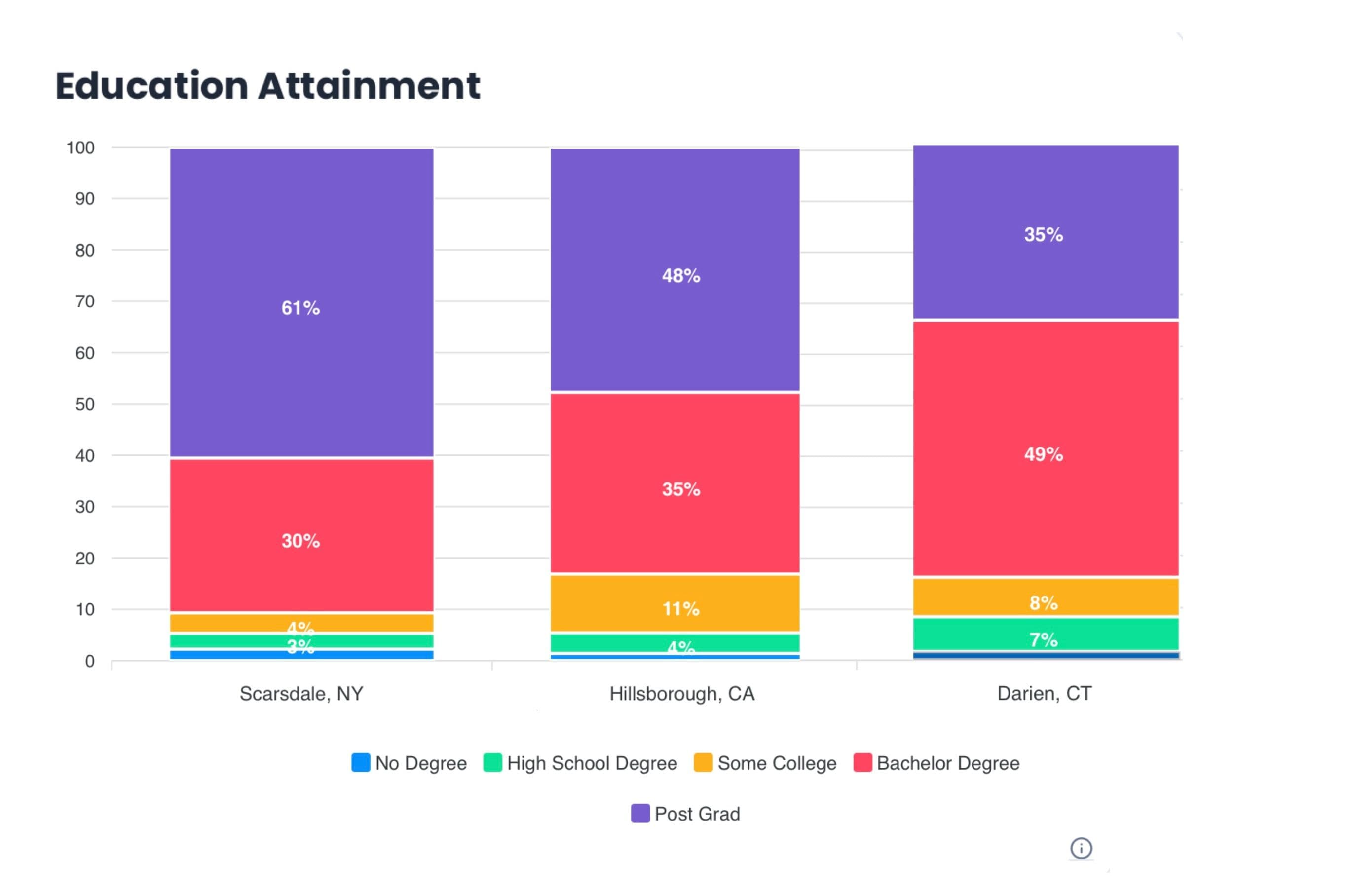
To begin our investigation, let’s look at some of the richest cities in the U.S. We’ll use Hillsborough, CA, Darien, CT, and Scarsdale, NY. According to StatisNostics, a database that utilizes U.S. government census data, Darien’s median household income rests at $248,125. StatisNostics also reports that 84% of residents received higher education (with 49% receiving their bachelor’s degree and 35% receiving a postgraduate degree). Hillsborough and Scarsdale both boast a median household income of $250,000. For these cities, we see the same trend as in Darien. In Hillsborough, 83% of residents received higher education (35% bachelor’s degree and 48% post-grad), and in Scarsdale the number reached 91% (30% bachelor’s degree and 61% post-grad). So it seems like the Bureau of Labor’s adage is holding up, for now.
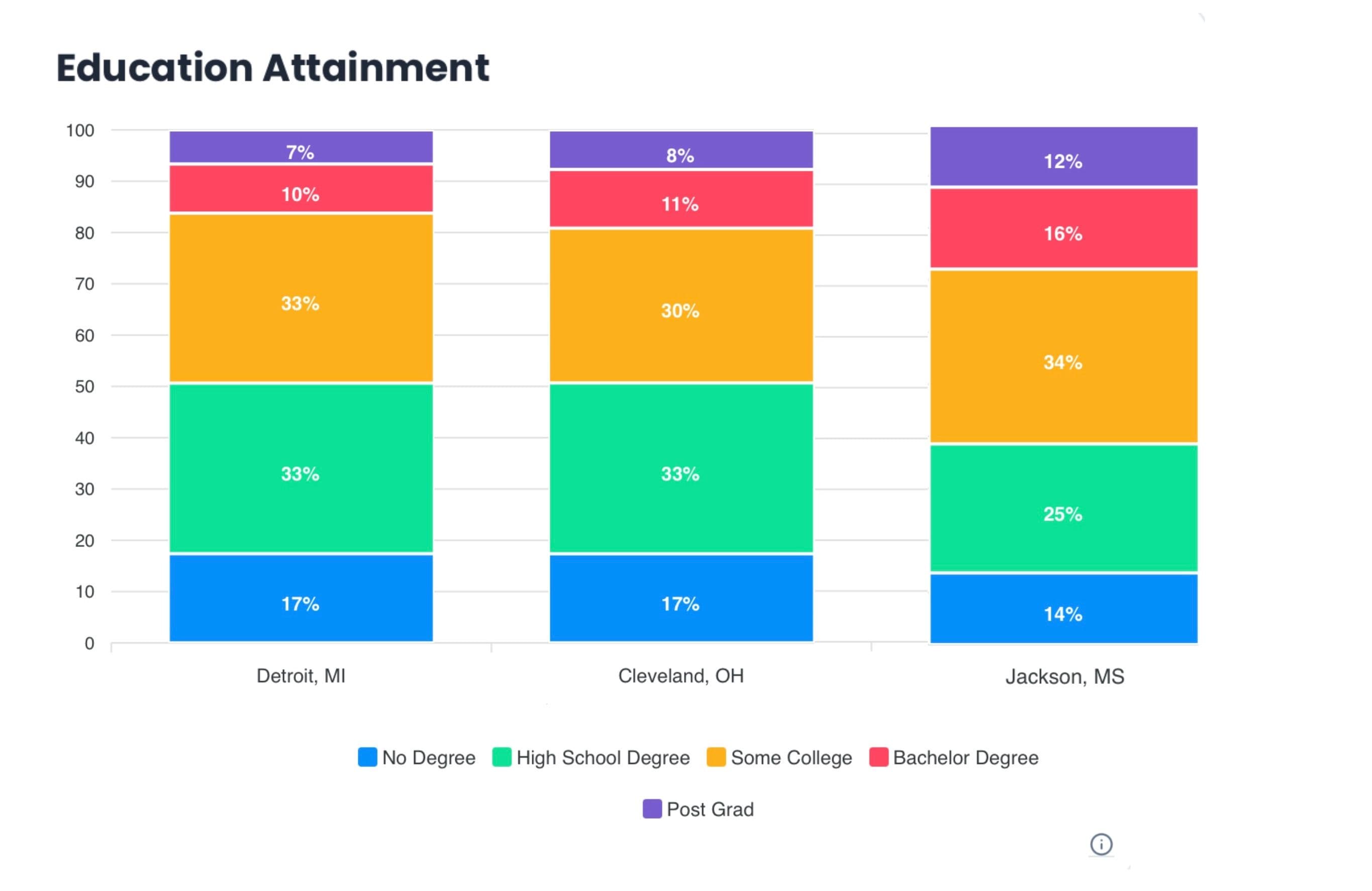
Let’s shift to some of America’s poorest cities and see if the trend continues. We’ll take Detroit, MI, Cleveland, OH, and Jackson, MS. In Jackson, the median household income is $39,969. Also in Jackson, only 28% of residents received higher education (16% bachelor’s degree and 12% post-grad). In Cleveland, the median household income is $33,678, and only 19% of residents received postsecondary education (11% bachelor’s degree and 8% post-grad). Detroit’s median household income rests at $34,762 with only 17% of residents receiving higher education (10% bachelor’s degree and 7% post-grad).
Based on the numbers so far, it’s reasonable to say that higher education does, in fact, result in higher income. So that’s it? The Bureau of Labor Statistics wins, and the only way to be economically successful is through a degree?
The answer? No.
The evidence? The Amish.
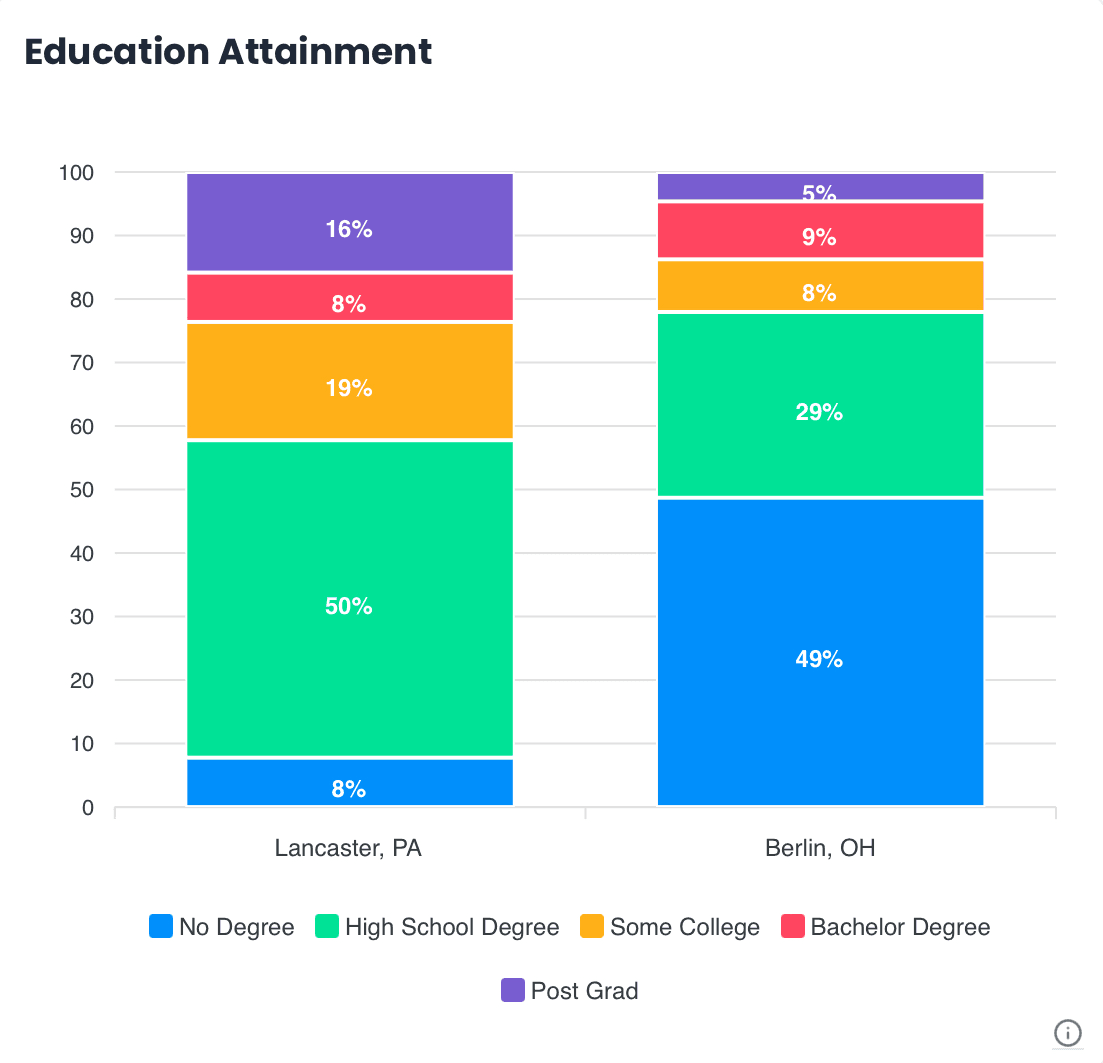
StatisNostics analyzed two of the largest Amish communities in the nation, Lancaster County, PA and Holmes County, OH. In Berlin, OH (located in Holmes County), the median household income is $72,778. While Berlin’s median income more than doubles the income of both Cleveland’s and Detroit’s, the Amish city has even lower education attainment. Only 14% of Berlin residents have obtained higher education (9% bachelor’s degree and 5% post-grad). Lancaster, PA, home to the largest Amish community in America, has a median household income of $96,250. Along with pushing six figures, only 24% of Lancaster residents have received higher education (8% bachelor’s degree and 16% post-grad). Less than a fourth of the population has completed postsecondary education, yet they’ve still been able to prosper financially.
So what’s their secret? Well, first and foremost, the Amish have a very strong work ethic. The time they save by not pursuing secondary and postsecondary education, they spend learning trades like agriculture, carpentry, and sewing handmade clothing. The Amish have learned how to produce, sell, and become entrepreneurs without a high school diploma, let alone a PhD. Even without a postgraduate degree, Amish small businesses have a 95% success rate. The five-year survival rate of all U.S. small businesses is only 50%.
Secondly, the Amish know how to save. According to the Education Data Initiative, public postsecondary schools spend an average of $30,230 per student. In Mississippi, public colleges and universities spend approximately $34,350 per student. Also in Mississippi is Jackson, the city that, if we recall, has a median household income of a little under $40K. Ohio, home to the Amish community of Holmes County, only spends $25,270 per student on postsecondary education. Although the state invests thousands of dollars less, the Amish city of Berlin still has a median household income of over $70K. The Amish have actually managed to turn their eighth-grade educations into an asset, while simultaneously demonstrating that debt accumulated from higher education proves to be a liability. But education isn’t the only thing that the Amish are saving money on. The Amish make most, if not all, of their own goods so there isn’t much need to shop. They also prioritize saving. On average, the Amish adult saves 20% of their income, while the average American saves less than 5%.
Lastly, the Amish have learned how to be content. In a capitalist society, it’s become commonplace to constantly consume. But, the Amish have learned to be content with what they have. They haven’t settled for less, they simply don’t need more. In his book, Small is Beautiful, E.F. Schumacher argued that capitalism has provided economic progress at the expense of culture and human contentment. Schumacher writes, “where is the rich society that says: ‘Halt! We have enough’?” Well, it may be reasonable to conclude that the Amish are the rich society Schumacher was looking for.
To close things out, let’s come up with some answers. But first, a callback to Plutarch. In Symposiacs, he decided that both the chicken and the egg came first. Plutarch asserted the egg “begets and contains everything,” so it must’ve come first. At the same time, he also argued the chicken was first since creation was “self-sufficient and entire” in the beginning. What does this mean for this week’s topic? Is higher education attainment directly tied to higher income? In true Plutarch fashion, the conclusion is yes and no. Completing higher education does qualify one to receive a higher paying job, however, a degree is not the only way to achieve financial success. While education is still incredibly important, don’t feel pressured to run on the postsecondary treadmill. Look at Bill Gates and Steve Jobs! Or better yet, look at the Amish.
1. These Are the 10 Poorest Cities in the U.S. | Healthiest Communities Health News | U.S. News, www.usnews.com/news/health-news/slideshows/poorest-cities-in-the-us. Accessed 24 July 2024.
2. “School Data Comparison.” StatisNostics, statisnostics.com/schools/compare?address1=2395%2BCovered%2BBridge%2BDr%2C%2BLancaster%2C%2BPA%2B17602&address2=berlin%2C%2BOH. Accessed 24 July 2024.
3.“Small Is Beautiful Quotes by Ernst F. Schumacher.” Goodreads, Goodreads, www.goodreads.com/work/quotes/1417527-small-is-beautiful-economics-as-if-people-mattered. Accessed 24 July 2024.
4. Breyer, Melissa. “Finally Answered! Which Came First, the Chicken or the Egg?” Treehugger, Treehugger, 16 Aug. 2023, www.treehugger.com/finally-answered-which-came-first-the-chicken-or-the-egg-4864321#:~:text=He%20went%20with%20the%20decidedly,self%2Dsufficient%20and%20entire.”
5. “Nine Money Secrets of the Amish.” The Christian Science Monitor, The Christian Science Monitor, 28 Sept. 2015, www.csmonitor.com/Business/Saving-Money/2015/0928/Nine-money-secrets-of-the-Amish.
6. Durisin, Megan. “13 Money Secrets from the Amish.” Business Insider, Business Insider, www.businessinsider.com/money-secrets-of-the-amish-2013-4#they-loathe-debt-and-try-to-avoid-credit-cards-3. Accessed 24 July 2024.
7. “Learn More, Earn More: Education Leads to Higher Wages, Lower Unemployment.” U.S. Bureau of Labor Statistics, U.S. Bureau of Labor Statistics, www.bls.gov/careeroutlook/2020/data-on-display/education-pays.htm. Accessed 24 July 2024.
Cover Photo Credit: <ahref="https://www.vecteezy.com/free-vector/education">Education Vectors by Vecteezy</a>