
StatisNostics examines how the economic decline in China will impact the U.S.
Date Published
For the past year or so, China has been experiencing an economic downturn. Their economy, which usually grows at an annual rate of 7-8%, is now growing at a rate of less than 5%. Despite reassurances from Chinese President Xi Jinping to U.S. executives about the health and sustainability of the Chinese economy, residents and foreign investors alike are concerned about the slowdown.
Forbes compared China’s current economic situation to that of the Great Depression. Not because China’s economy has completely collapsed, but rather because the citizens of China have lost trust in borrowing and spending funds. During the Depression, economist John Maynard Keynes illustrated that any monetary stimulus from the government or the Federal Reserve will only be beneficial if the consumers have the confidence to utilize it. In the case of the Depression and China’s current economic slowdown, residents are reluctant to consume.
But, how will this impact the U.S. economy? Like Chinese residents, Americans are also less inclined to purchase Chinese goods. In August of 2022, the U.S. spent a staggering 50.38 billion dollars on Chinese goods/exports. Just 10 months later in June of 2023, that number dropped dramatically to 34.33 billion dollars. American companies like Tesla and Apple are also starting to lose money in China, as Chinese residents decrease their spending. A silver lining, however, of China’s financial misfortune is a potential decrease of inflation in America. Since China is exporting their goods in surplus at lower rates, this could lower overall prices for Americans.
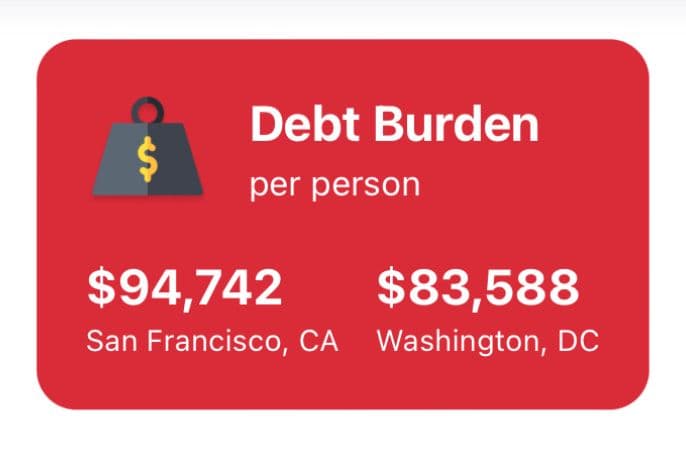
This could also mean an improvement for debt-ridden cities in the U.S. Tech hotspots San Francisco, CA and Washington, D.C. were both run through StatisNostics, a database that utilizes U.S. government census data. According to the database, the debt burden per person in D.C. is $83,588, and the burden in San Francisco totals $94,742. With lower inflation due to China’s economic decline, we could start to see a drop in these numbers as well.
Whether or not China’s economy will begin to recover is unclear, but one thing is apparent: the effects of the financial crisis extend far beyond the country’s own borders.
If you’re curious about the financial statistics for your own city, visit www.statisnostics.com. By simply entering your address in the search bar, you will receive information on your city/town’s economic data, government, real estate, demographics, public safety, health, schools, and climate.
1. Depillis, Lydia. “What China’s Economic Woes May Mean for the U.S.” The New York Times, The New York Times, 26 Aug. 2023, www.nytimes.com/2023/08/26/business/economy/us-economy-china.html.
2. Ezrati, Milton. “China’s Economy Has Picked up Traits Reminiscent of the Great Depression.” Forbes, Forbes Magazine, 20 Feb. 2024, www.forbes.com/sites/miltonezrati/2024/01/22/chinas-economy-has-picked-up-traits-reminiscent-of-the-great-depression/?sh=6522f0244a80.
3. “China’s XI Meets American CEOS in Bid to Boost Confidence in Ailing Economy.” NBCNews.Com, NBCUniversal News Group, www.nbcnews.com/news/world/china-xi-jinping-economy-american-business-apple-blackstone-great-hall-rcna145231. Accessed 15 Apr. 2024.
4. “As China’s Economy Falters, so Does Middle-Class Confidence.” NBCNews.Com, NBCUniversal News Group, www.nbcnews.com/news/world/china-economy-falters-middle-class-confidence-xi-business-rcna145809. Accessed 15 Apr. 2024.