
Poorest of the Four— StatisNostics examines why the South is the U.S. region with the highest poverty rates.
Date Published
The United States is split up into four regions: The Northeast, Midwest, West, and the South. This week, we’re diving into how the Southern region has become the poorest of the four. The South’s elevated poverty rates date all the way back to the Civil War. The South had been essentially decimated after the Union’s victory over the Confederates: cities were demolished, crops were destroyed, and railroads were torn up from the ground. Due to this devastation, the South was unable to industrialize to the same degree as the North, and the value of their goods decreased immensely. Southerners tried to sell land but only received small sums of money for their plots. For African Americans during this time, circumstances were even worse. Unable to acquire land, they earned their wages planting cotton. During the growing season, however, African Americans would often run out of money forcing them into loan debt— a terrible position in an already-terrible situation. Bottom line: the South was unable to keep up with economic and industrial advances causing a monetary disparity between them and the rest of the nation.
Due to decades of building upon this shaky groundwork, the South continues to be the poorest region in the United States. Various cities in the South were run through StatisNostics, a database that utilizes U.S. government census data, in order to examine the poverty rates in Southern areas. In Jackson, Mississippi, 23% of residents ages 18-54 are below the poverty line. 40% of Jackson residents under age 18 are also below the line. In New Orleans, Louisiana, 21% of citizens 18-54 are below the poverty line. In Pharr, Texas it’s 27%, and in Albany, Georgia the rate creeps up to 28%. To compare these percentages to the number of residents below the poverty line in Northern cities, the rate is only 17% in Columbus, OH, 16% in Minneapolis, MN, and 15% in Chicago, IL.
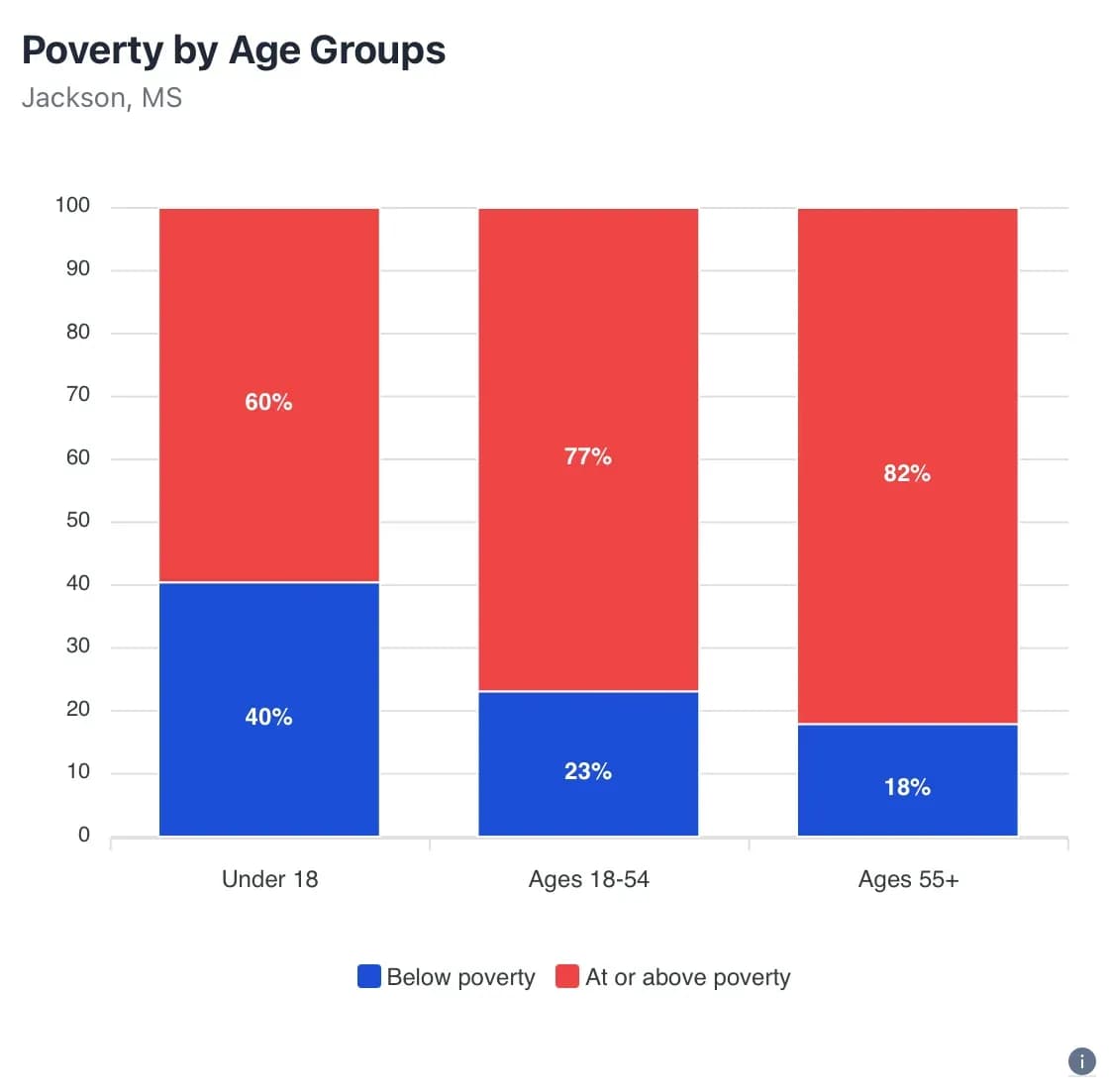
The numbers don’t lie, Southern cities do generally have higher poverty rates than cities up north.
In the 1940s, Henry Ford predicted modern society would have flying cars by now. Instead, we’re dealing with the economic repercussions of a 163-year-old war. Will the South make an eventual financial comeback? I guess we’ll have to wait another 163 years to find out.
If you’re curious about the poverty rates for your own city, visit www.statisnostics.com. By simply entering your address in the search bar, you will receive information on your city/town’s economic data, government, real estate, demographics, public safety, health, schools, and climate.
1. Benson, Craig. “341 U.S. Counties Experiencing Persistent Poverty.” Census.Gov, 22 May 2023, www.census.gov/library/stories/2023/05/persistent-poverty-areas-with-long-term-high-poverty.html#:~:text=More%20than%20half%20(54.9%25),slice%20of%20the%20nation%27s%20population.
2. MDC Email. “What Went Wrong with the South?” Facing South, www.facingsouth.org/2015/11/what-went-wrong-with-the-south.html#:~:text=The%20historical%20roots%20of%20this,the%20pattern%20of%20ancient%20coastlines). Accessed 21 Feb. 2024.
3. University of New Mexico. “The South After the Civil War.” Department of Computer Science, www.cs.unm.edu/~sergiy/amhistory/ch21.html. Accessed 21 Feb. 2024.
Cover Photo Credit: SurfUpVector