
No Taxation Without Government Inundation: How the Overwhelm of Government Spending Affects Taxation.
Date Published
This week, we’re getting back to Spending Pressure. Now if you don’t know what Spending Pressure is or you need a little refresher, we suggest going back to our introductory article. If you’re all caught up to speed, we can begin our discussion on how government spending and Spending Pressure impact taxation, and what that means for you as a taxpayer.
In this hypothetical scenario, imagine you’re running a lemonade stand. You purchase the supplies to make the lemonade as well as materials for creating adequate signage to market your product. It’s summer, and temperatures are creeping into the triple digits. So, since it’s hot and people are thirsty, you naturally receive a lot of traffic. Your business booms for the months of June and July, and you gain so much traction that your local government requires you to now pay a sales tax every month. After all, the government is spending thousands of dollars to pave the sidewalk where you're selling your lemonade. The least you can do is slide them a couple of bucks, right? The business continues to be a success well into November (you live somewhere really hot), but things begin to slow down once December hits. Temperatures begin to plummet, people are swapping out their short sleeves for winter coats, and the last thing on anyone’s mind is an ice-cold glass of lemonade. The demand for your product has decreased dramatically, so much so, that you can no longer afford to pay sales tax to the government. They don’t like that very much. The government eventually resorts to seizing your personal and business assets to make up for past due tax, penalty, and interest. Your business falls apart and you find yourself in debt to the government.
So, what’s the takeaway here? Even though the value of your business/product decreased, that doesn’t change the fact that the government always needs funds to supplement their spending— and they’re going to get them, one way or another.
Which brings us back to property tax. Your home or commercial property may go up or down in value. The money needed by units of government, however, does not decrease just because your property goes down in value, which is why your taxes can go up even if the value of your property goes down. Because they keep right on spending. This inundation, or intense flood, of government spending only results in a steady climb in taxation.
Your consequent Spending Pressure increases the tax claims against your property. Spending, in turn, is funded not only by the amount taxed from you right now, but also by the amount that the government spenders have “borrowed” from someone else, adding to the amount that must be spent later to repay the debt. How will this repayment take place? More taxation. Let’s take a look at Los Angeles. According to StatisNostics, a database that utilizes U.S. government census data, LA spends $29,541 per capita and has racked up a debt burden of $82,614 per capita. To decrease the debt burden, will their government try to decrease their spending? Come on, we know better than that by now. The solution for knocking down the burden will be to increase taxes for LA residents, allowing the residents to pay back the debt. Now, if the benefits that the Los Angeles government provided were worth the amount that residents paid in taxes, all would be well. However, looking at the city’s Spending Pressure score of 84/100, this cannot be the case.
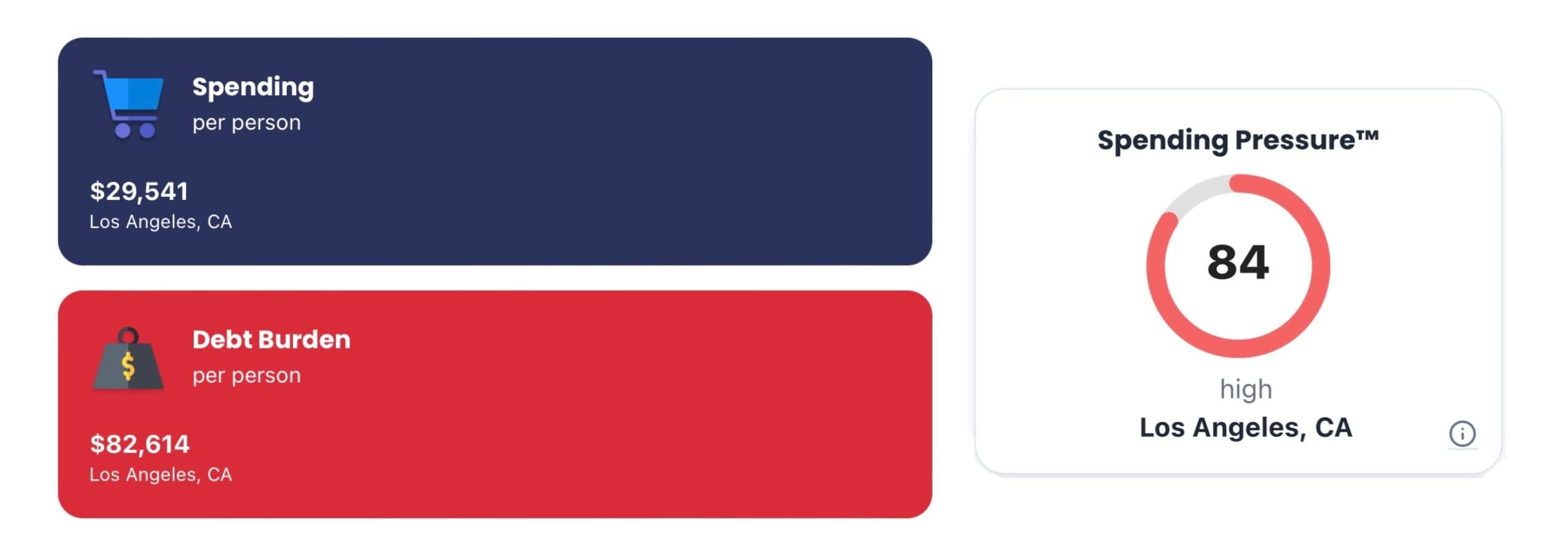
But, it’s not just LA. Many city and state governments in the U.S. have extremely high Spending Pressure (i.e. Washington, D.C. and Anchorage, AK both have a score of 98). In this sense, the taxpayers fall victim to assurance of spending unseen. Current taxes are “only…immediate; since taxing “manifests itself simultaneously with its cause---it is seen.”1 Whereas debts “unfold in succession—they are not seen” until they arrive in the form of future taxes.
Consider all of the Spending Pressure you feel as a simplified proof of your existence: “I am taxed, therefore I am.” Spending Pressure shows that in order to exist, you must pay your way through life in a jurisdiction more heavily pressurized against you.
So, when life gives you lemons, you’ll probably be taxed on them to refund government spending.
1. Fredric Bastiat, What is Seen and What is Not Seen (1850) from Introduction.