
Journey to the Center of the Illinois Pension Code
Date Published
This article originally appeared in the DuPage County Bar Association Brief, Volume 36, Issue 5, and has been reprinted with permission.
The 1864 French science fiction novel Journey to the Center of the Earth follows an expedition by eccentric geology professor Otto Lidenbrock, his nephew Axel, and a local guide Hans down a passageway below the depths of Iceland to the center of the Earth.1 At the center of the earth, the trio find a volcanic chimney whose pressure blows them back up to the Earth’s surface, where they land in Sicily. Climbing down the depths of the Illinois Pension Code reveals a similarly pressurized center, as we shall see on our own difficult and complex journey.2
Fire and Police Pension Code Overview
The Illinois Pension Code (hereafter, “Code”) is found in Chapter 40 of the Illinois Compiled Statutes,3 with separate sections for fire and police pensions. The section pertaining to police is found in Article 3, with fire in Article 4. Both articles are similar, except that pension benefits for firefighters skew mathematically higher than for police. We will cite mainly from Article 3, to avoid duplicative mirror cites from Article 4.
The board of each municipal pension fund is established by the Code—one for police and one for fire. How the board is staffed with trustees, and what they can do, are all spelled out. The fire and pension boards each have five members. Two are appointed by the mayor, two are elected by the employees participating in the fund, and one is elected by the current beneficiaries.4 This means that the beneficiaries dominate each board with a 3-2 majority.
The Code also defines a beneficiary, to include “retired pensioners, disabled pensioners, their surviving spouses, minor children, disabled children, and dependent parents.”5 Fire and police pension boards approve claims for those funds to pay for retirements, spousal death benefits, and disability benefits. It’s as if there are three insurance companies in each fund. Since all of these beneficiaries are on the receiving end of defined benefits keyed to their lifetimes, no set amount of money can be determined at any one time to fund those benefits. It is a moving target in need of constant adjustment.
Another responsibility of each board is to make sure that the pensions are properly funded. The Code mandates these pensions to be actuarially funded to at least 90% of their liabilities by 2040. Very few of them are. Many hover at 20% or maybe 55%. To pick up the slack between now and 2040, each town must pump more money into these funds by levying taxes against property holders in the municipality.6 The State of Illinois pays nothing, and never has. It’s all on the local taxpayers.
Given that the pension boards are stacked 3-2 against the municipalities, the Code thus contains what economists call a systemic incentive problem. Those running the funds have the incentive to run up the liabilities that translate into higher payments to themselves.
Benefits
The Code lays out how much money a police officer or firefighter will receive based on their salary at the time of death, retirement, or disability. A retiring police officer or firefighter can expect to receive at least half of their salary as a pension upon retirement, to at most 75% of their salary.7 Additionally, Section 3-111.1 includes the notorious 3% annual compounding language, where 3% of the originally granted pension must be added to a pensioner’s monthly pension each year.8 Since Article 13, Section 5 of the Illinois Constitution explicitly forbids decreasing pension benefits,9 the municipality must fund (i) the difference if the pension fund doesn’t perform well enough to match this guaranteed increase; and (ii) all additional benefit increases regularly legislated into place by Springfield lawmakers.
So as we pause on our downward journey, like the explorers in the story, who were guided by the carved initials on the walls of rock they passed, we can see the initials of various legislators etched into the public laws enacting these increased benefits, pushing each town deeper into spending. We can also see the names of Illinois Governors traced on various pension benefit increase bills.10
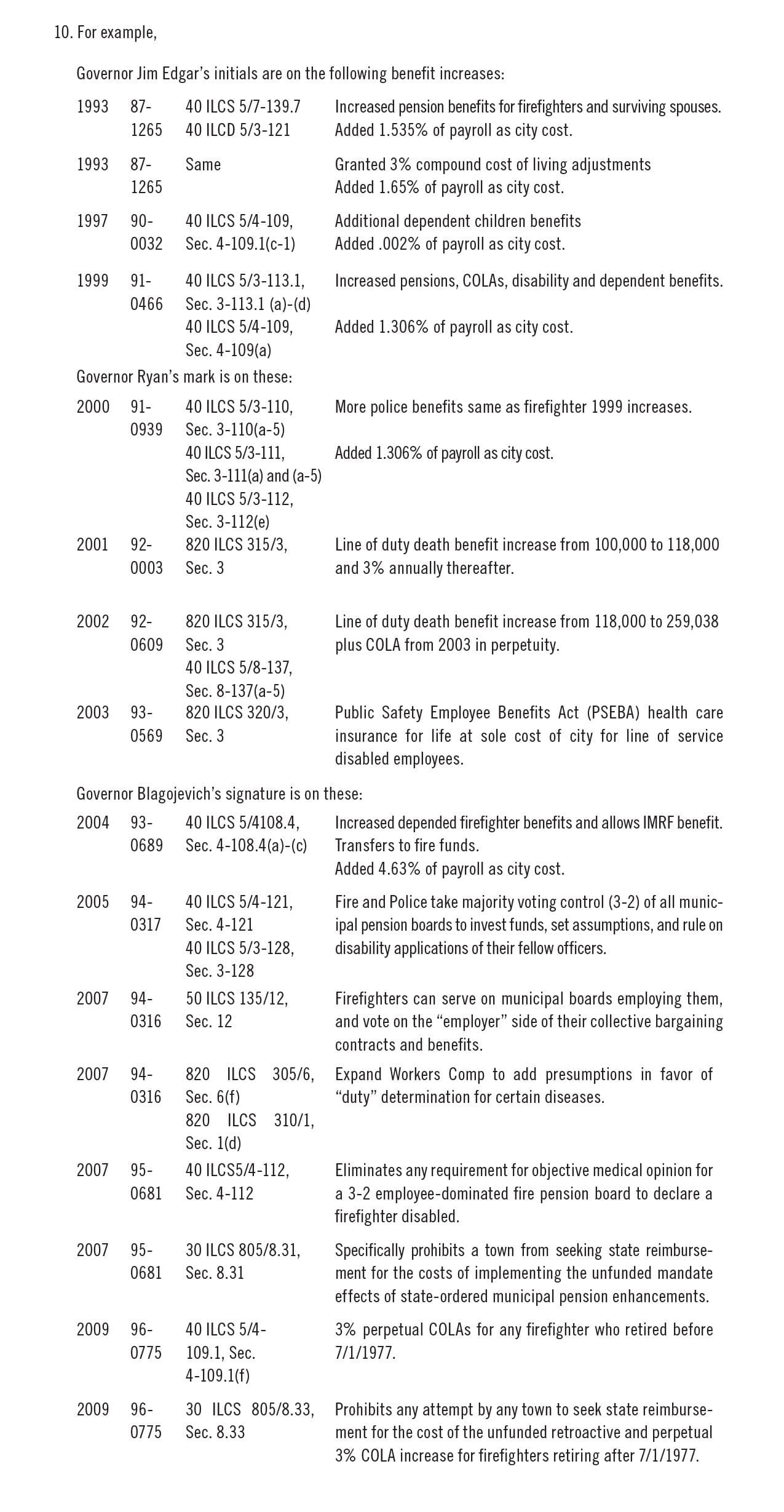
Additionally, the spouse of a deceased police officer or firefighter gets 100% of their annual lifetime benefit, for the life of the surviving spouse, even if they get remarried.11To take a full account of a municipality’s pension liability, the pension board must also take into consideration the life expectancy of all spouses and subsequent spouses of our fire and police officers. All of this indeterminacy must be absorbed by the municipality’s general fund.
Disability
Eligible police officers and firefighters also receive disability benefits as part of their pension.12 Whether or not a police officer is disabled in the line of duty is determined by the pension board. However, unlike any plaintiff’s personal injury lawyer, who must face defense counsel armed with the AMA Guides to the Evaluation of Permanent Impairment13 to convince a jury to award damages, the board does not have to use objective medical evidence or opinion to make a determination of disability.
The AMA’s Guides are an objective medical standard used in the conduct of personal injury suits, and by employers to contest impairment ratings in workers’ compensation cases. But since 2007, no such AMA standards apply to police or fire disability claims in Illinois. Instead, disability claims are simply evaluated by three physicians who are selected and paid for by the board, and they “need not agree as to the existence of any disability or the nature and extent of a disability” for disability benefits to be granted.14
Pension Fund Composition
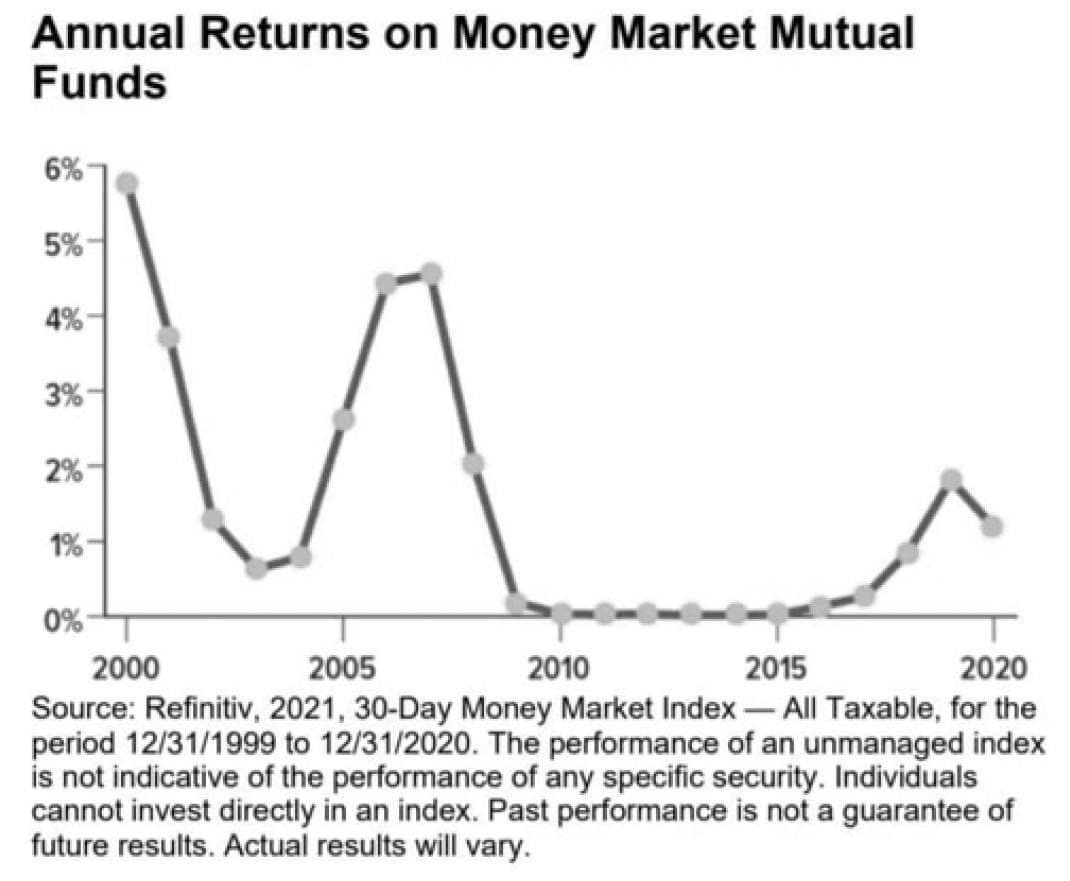
The Code historically restricted the kinds of things in which the pension board may invest. 45% of fire and police pension funds must be invested in interest-bearing items, like U.S. Treasury bonds or money market funds.15 Up to 55% of the fund may be invested in stocks and mutual funds, but alternative investments like private equity and real estate are not permitted.16 Given that most of the 2010s were spent with interest rates being near zero, the performance of these pension funds took major hits. Only recently have interest rate hikes started to improve fund performance.17
Last year was the first full year of operation for the new “pooled” management of each town’s pension funds by two new state-wide boards handling consolidated investment of 653 suburban and downstate police and fire pension funds.18 The pooled funds each have the following trustee representatives: three pension fund “participant” representatives; two “beneficiary” representatives; three “municipal” representatives; and one representative from the Illinois Municipal League. So the beneficiaries continue to dominate the pooled state investment fund just as they do at the level of the individual town funds, which still exist to adjudicate disability and benefit determinations paid for with each town’s account held now by the pool.
The two pools now have their own investment advisors as well, who bill their expenses to those same police and fire funds. The new consolidated funds were also empowered to change the investment mix of the funds, and now the fire fund, for example, has made an “interim” allocation of 30% to fixed income, 65% to equities, and 5% to real estate. The fire fund plans for a “permanent” allocation of 25% fixed income, 55% equities, and 20% alternative (broken down into four segments of 5% each to private equity, real estate, infrastructure, and credit).19 This should provide some better performance relative to the prior 45% requirement for interest-bearing instruments. However, neither the investment advisors nor the new consolidated state boards are held accountable for investment losses, because each municipality still has the burden to make up the difference between their account balance and claims on that account from their local fire and police fund beneficiaries. So the only result of poor investment performance is the imposition of higher taxes to restore the difference.
Polarized Incentives and the Ratchet That Only Tightens
Article 13, Section 5 of the Illinois Constitution states that “Membership in any pension or retirement system of the State… shall not be diminished or impaired.”20 This, combined with Section 3-125 of the Pension Code (the municipality must make up the difference to maintain funding for the pensions) means that municipalities are constantly working with a system that always needs increasing funds. Funding can never be loosened or reduced. This is like trying to fix your car with a ratchet that only tightens.
Additionally, municipalities have little to no recourse against this system. They are unable to “bargain” for any pension, survivor, or disability benefits they must pay because of the Illinois Public Labor Relations Act.21 If a town were to just throw in the towel and refuse to fund these pensions, a cascade of penalties would kick in. First, the state would impose a diversion of sales tax revenue from the town straight into the pension funds. Following that, there will be court-ordered real estate tax increases, and, if all else fails, municipal asset forfeitures.22
Spending Pressure
The ultimate consequence of this system is to pressurize spending obligations on taxpayers in Illinois municipalities. “Spending Pressure” can be expressed as a score derived from a mathematical formula to quantify the economic burden government spending imposes on a given area.23 As income, goods, and real estate are taxed to finance new government spending, this decreases the real economic value of the property.
When it comes to pensions, calculating spending pressure used to be somewhat anecdotal. With the introduction of GASB 68 in June 2015, however, local governments now must disclose unfunded pension liabilities on their balance sheets, to reflect drastic impairment of their financial position.24 Moreover, the inclusion of GASB 68 standards forces Illinois towns to project for the very first time what these unfunded pension liabilities will look like decades into the future. Here is where we see the core consequences of our pension system design. Illinois residents are going to have to face higher taxes or cuts to government services to fund an overwhelming pension liability that can only get larger. One study from the Illinois Policy Institute shows the consequent displacement of public safety spending caused by these mounting pension obligations. In Lake County, for example, between 1999 and 2019, “[r]esidents saw funding to fire departments cut by $1.3 million while funding for fire pensions increased by $13.8 million” (emphasis added).25
This pressure from expanding pension benefits has been shown to impact towns with lower home values. According to a study by Crain’s Chicago Business, Illinois suburbs with lower home values “have fallen into a familiar pattern of decline amid collapsing property values and skyrocketing property taxes to pay for schools, police, and fire protection.”26 In some towns, the property tax rate is upwards of 15% of a home’s market value, and this burden disproportionately affects low-income homeowners living in less expensive homes.27 Trying to raise taxes yet higher in these towns just further lowers already flattened property values and accelerates disinvestment from those communities.28 Spending pressure induced by pensions will blow residents right out of such towns with such high levels of taxes-to-equalized assessed values. As Cook County Treasurer Maria Pappas has observed, “The idea behind this is for people to begin to understand that when they purchase a piece of real estate in Cook County, they are also purchasing a long-term credit card.”29
Conclusion
Here at the end of our journey, now we see that you are at the center of the Illinois Pension Code, living under the increasing pressure carved into your town’s financials, that may eventually push you out of Illinois.
For as we have seen, that pressure has been induced by a system set up by the Illinois Pension Code, with few incentives for Springfield or the public safety unions to set realistic benefits or make sound investment decisions. And unlike a Jules Verne novel, none of this is science fiction.
1. Professor Lidenbrock is guided by an old diary of Arne Saknussemm, who found the passage 300 years before, and whose initials “A.S.” are helpfully scrawled on various rocks and landmarks along the way down their journey.
2. In the story, an Icelandic runic manuscript advises: “Go down into the crater of Snaefells Jokull, which Scartaris’s shadow caresses just before the calends of July, O daring traveler, and you’ll make it to the center of the earth. I’ve done so. Arne Saknussemm.” Jules Verne, Project Gutenberg’s A Journey to the Centre of the Earth, https://www.gutenberg.org/files/18857/18857-h/18857-h.htm.
3. 40 ILCS 5/.
4. 40 ILCS 5/3-128.
5. 40 ILCS 5/3-108.3.
6. The Code specifically requires:
[t]he city council or the board of trustees of the municipality shall annually levy a tax upon all the taxable property of the municipality at the rate on the dollar which will produce an amount which, when added to the deductions from the salaries or wages of police officers, and revenues available from other sources, will equal a sum sufficient to meet the annual requirements of the police pension fund. The annual requirements to be provided by such tax levy are equal to (1) the normal cost of the pension fund for the year involved, plus (2) an amount sufficient to bring the total assets of the pension fund up to 90% of the total actuarial liabilities of the pension fund by the end of municipal fiscal year 2040, as annually updated and determined by an enrolled actuary employed by the Illinois Department of Insurance or by an enrolled actuary retained by the pension fund or the municipality. In making these determinations, the required minimum employer contribution shall be calculated each year as a level percentage of payroll over the years remaining up to and including fiscal year 2040 and shall be determined under the projected unit credit actuarial cost method. The tax shall be levied and collected in the same manner as the general taxes of the municipality, and in addition to all other taxes now or hereafter authorized to be levied upon all property within the municipality, and shall be in addition to the amount authorized to be levied for general purposes as provided by Section 8-3-1 of the Illinois Municipal Code, approved May 29, 1961, as amended. The tax shall be forwarded directly to the treasurer of the board within 30 business days after receipt by the county.40 ILCS 5/3-125.
7. 40 ILCS 5/3-111; 40 ILCS 5/4-109.
8. 40 ILCS 5/3-111.
9. See, Edward Tiesenga, Democracy in DuPage: Perpetual Public Benefits and the Illinois Constitution, DCBA Brief (Jan./Feb. 2023).
10. See image
11. 40 ILCS 5/3-121.
12. 40 ILCS 5/3-114.1.
13. Guides to the Evaluation of Permanent Impairment, American Medical Association (4th Ed. 1993). As the Foreward to the Guides states: “the purpose…[is] to bring greater objectivity to estimating the degree of long-standing or ‘permanent’ impairments.” So when this standard is excluded by the Illinois Pension Code, that exclusion reasonably implies that less objectivity applies to estimating work-related disabilities when the pension boards vote to declare a police officer or firefighter to be disabled.
14. 40 ILCS 5/4-112; signed by Governor Blagojevich in 2007.
15. 40 ILCS 5/1-113.2.
16. 40 ILCS 5/1-113.4.
17. Henssler Financial, Money Market Funds in a Low Rate Environment, https://www.henssler.com/money-market-funds-in-a-low-rate-environment.
18. See generally, Report to Governor JB Pritzker: Illinois Pension Consolidation Feasibility Task Force, Oct. 10, 2019.
19. See, “Firefighters’ Pension Investment Fund: An Update on Consolidation,” Illinois Municipal Review (Nov. 2021) at 22-23.
20. Ill. Const. art. 13, sec. 5.
21. 5 ILCS 315/1, Sec. 7.5.
22. See 40 ILCS 5/4-118, Sec. 4-118(b-5) for Fire, and 40 ILCS 5/3-125, Sec. 3-125 (c) for Police. Both provisions require the Illinois Comptroller to divert any State funds the municipality would otherwise receive, and instead pay those monies directly to the police and fire pension funds. This is a new provision that first took effect in 2016 “and each fiscal year thereafter,” and one of the actions taken by Governor Rauner was to issue regulations for this “diversion” to take effect when triggered by a town’s minimum threshold funding failure. The sales tax confiscation regime is set up and ready to go to feed more money into public sector pensions.The police can do this to enforce 40 ILCS 5/3-125, Sec. 3-125(a); and the fire employees can do this to enforce 40 ILCS 5/4-118, Sec. 4-118(a). Both of these statutes require the city council or trustees of a municipality to levy a tax on all of the real estate in the municipality to meet the annual requirements of the pension funds.
23. See www.spendingpressure.com and https://spendingpressure.com/how-it-works
24. GASB, or Governmental Accounting Standard Board, is a project of the Financial Accounting Foundation that creates standards for best accounting practices that all governmental entities have to follow. GASB 68 has been incorporated into the Pension Code and those standards are now enforced on municipalities when they report expenses on their balance sheets. See, Statement No. 68, Accounting and Financial Reporting for Pensions (GASB).
25. Adam Schuster, The Policy Shop, Illinois Policy Institute (2021)
26. Casey Toner, In suburbs, spiral of decline becomes homeowners’ burden, Crain’s Chicago (Jul. 25, 2019).
27. The Crain’s article, supra fn. 27, profiles Ryan Dupree, an African-American man who bought a house in Park Forest for just $25,000, but who then has a tax bill of $3,800, 15.2% of the fair market value. For an $800,000 house in Oak Brook this would be like getting a $121,600 tax bill. Oak Brook tax bills are more like 1.5% of the fair market value of a property. Poor people are using their taxable income to pay the taxes that then fund the tax-free pension income guaranteed to fire and police beneficiaries. See also, Sarah Freisthat, Black and Latino Communities Hit Hard by Property Tax Hikes, Chicago Tribune, Aug. 17, 2021.
28. Richard Epstein recognizes this destructive path, “the feared-and most likely- result of this vicious circle is that the bubble that has burst in the real estate markets will burst elsewhere, due to entitlement programs that consume a disproportionate fraction of the nation’s wealth.” See Richard Epstein, Design For Liberty, (2011) at 148.
29. Pappas is quoted in Crains Chicago Business, Public Debt Weighs Heavily: Pappas report shows each Cook County property’s share of government borrowing, (by A.D. Quig, Jun. 7, 2021).