
Can schools use AI to improve their rankings? StatisNostics examines how artificial intelligence will impact high school education.
Date Published
While AI has stepped into the limelight in recent years, its origin dates all the way back to the mid 1900s. Alan Turing, an English mathematician and computer scientist, published “Computer Machinery and Intelligence” in 1950, coining the term “artificial intelligence” in the process. Since then, AI has been used for almost everything from Instagram posts, to teaching classes, to even performing surgeries. This week, StatisNostics is looking at how AI will specifically impact secondary education.
According to a study done by ACT in 2023, 46% of students in grades 10-12 reported they used AI assistant tools on a variety of assignments. The study also found that students with higher ACT composite scores were more likely to use AI tools than students with lower scores. So, will the usage of AI improve a student’s performance? If this is the case, high schools that incorporate more artificial intelligence into their curriculum may begin to rank and score higher than those that do not.
We took Naperville, IL, a U.S. city with a high composite school score, and compared it with Harlingen, TX, a U.S. city with a relatively low one. Naperville has a composite school score of 74/100 with an average reading score of 69 and a math score of 79. On the flip side, Harlingen has a composite score of 47 with an average reading score of 48 and a math score of 45.
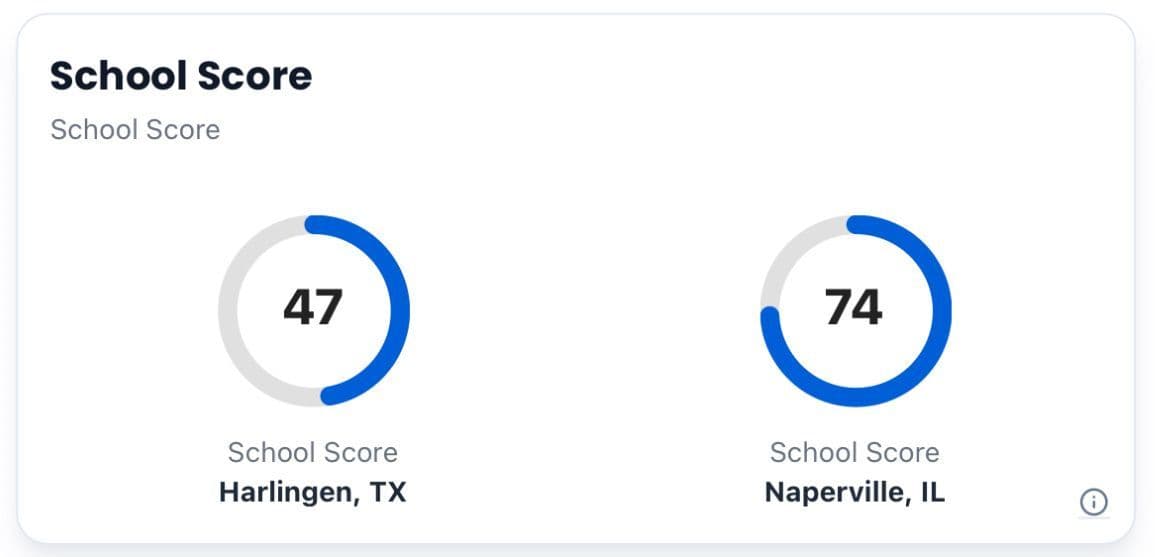
StatisNostics compares Harlingen, TX’s school score with Naperville, IL’s.
Based on the ACT study, artificial intelligence could help school districts in a city like Harlingen improve their composite score. However, many schools frown upon the use of AI claiming it diminishes students’ critical thinking skills and eliminates the ability to produce original ideas/work. Some teaching professionals also believe AI gives students an unfair advantage over other students who may not utilize it. Keeping this in mind, let’s speculate a moment:
For this scenario, we’ll keep using Naperville and Harlingen as an example. Harlingen decides they want to develop new curriculums for their schools using AI to help students learn better and boost their performance. This will, if all goes according to plan, increase their composite school score. Meanwhile, Naperville decides to not use AI at all, because they believe that it would be unethical. At the end of five years, Harlingen’s school score shoots up to 71 and Naperville’s score drops to 72. Now that the Harlingen schools and the Naperville schools equate in rank, is it fair that Harlingen used artificial intelligence to aid them or were they simply being resourceful?
As AI gains popularity in the classroom, educators are striving to understand it and use it ethically. Still, there are many who continue to worry that artificial intelligence will end up taking the place of teachers. Ginni Rometty, former CEO of IBM, endorses the use of AI, saying that it will “enhance us” and “augment our intelligence.” However, critics like Elon Musk, CEO of Tesla and SpaceX, believe that artificial intelligence could lead to a total takeover of the human race. Musk warns that without proper safeguards, using AI is like “summoning the demon.”
Curious about the school scores in your city/town? Visit www.statisnostics.com to discover info on not only the schools in your area, but to find stats on your city’s demographics, government, public safety, economics, schools, real estate, health and climate.
1. “Artificial Intelligence in Education: Teachers’ Opinions on AI in the Classroom.” Forbes, Forbes Magazine, 6 Mar. 2024, www.forbes.com/advisor/education/it-and-tech/artificial-intelligence-inschool https://leadershipblog.act.org/2023/12/students-ai-research.html
2. Sharmila. “AI Technology and Its Impact on High School Education.” UWorld College Readiness, 10 Apr. 2023, collegereadiness.uworld.com/blog/impact-of-ai-technology-on-ap-education/.
3. “What Is the History of Artificial Intelligence (AI)?” Tableau, www.tableau.com/data-insights/ai/history#: Accessed 18 July 2024.Cover Photo Credit: Nadya_Art // Shutterstock