
As the primaries are underway, StatisNostics looks at political percentages in the U.S. states that will decide the 2024 presidential election.
Date Published
“The ballot is stronger than the bullet.” -Abraham Lincoln
In his 1856 speech, Lincoln emphasized that voter ballots and participation are the most peaceful ways to facilitate change in the U.S. However, as the country is now amidst its 60th presidential election, the race may be anything but peaceful. As both Trump and Biden continue the battle for ballots, multiple reports have concluded that six states will be the deciding factors in choosing the next president: Arizona, Georgia, Michigan, Nevada, Pennsylvania, and Wisconsin.
This week, StatisNostics is looking at how these states voted in the 2020 election and what that may mean for 2024.
According to StatisNostics, a database that utilizes U.S. government census data, voting Phoenix residents voted 46% Republican and 52.7% Democrat (with 1.3% voting “Other”) in the 2020 election.
In Atlanta, 90.4% of voters voted Democrat while only 8.2% voted Republican. Do those numbers seem a bit disproportionate for a swing state? Let’s compare these Atlanta percentages with numbers from less metropolitan Georgia cities. In Sardis, GA, 60% of voters voted Republican and 39.4% voted Democrat. In Sumner, GA, 80.1% of voters voted Republican with only 19.6% voting Democrat.
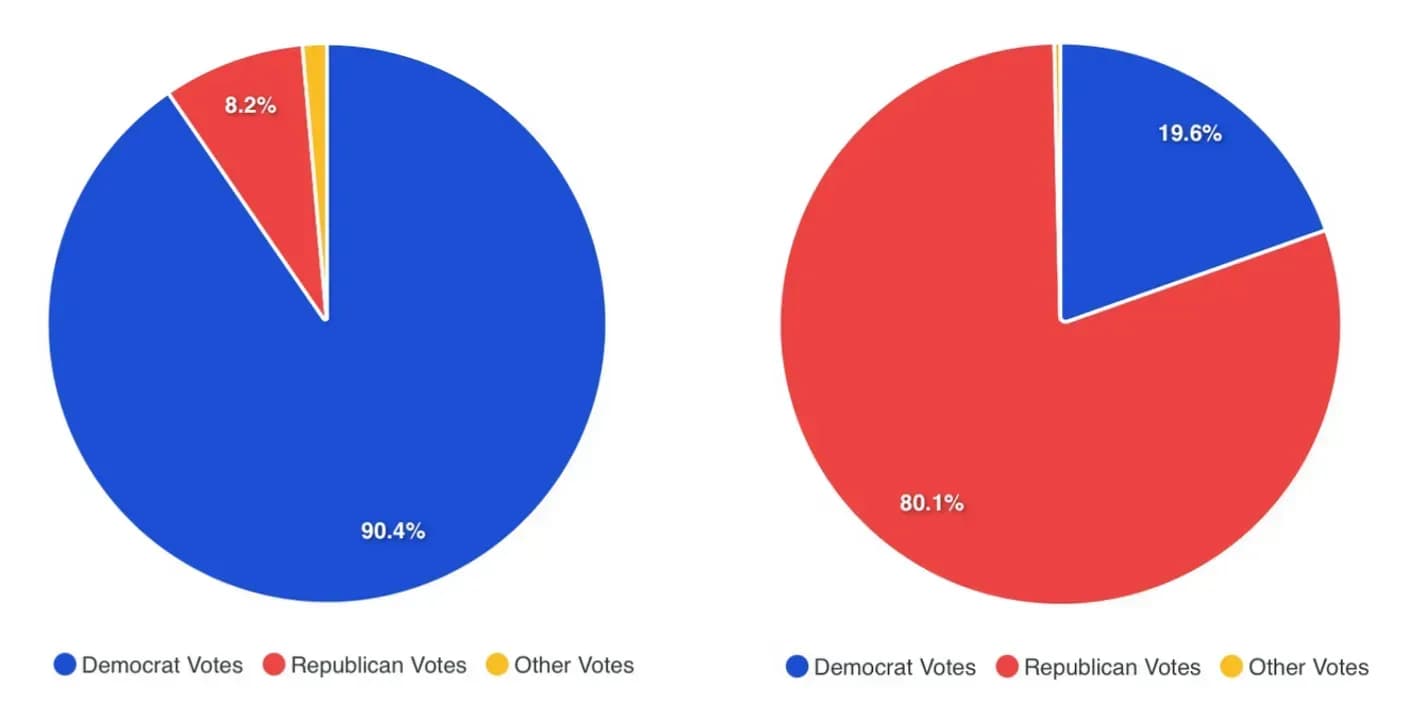
StatisNostics compares the 2020 election voting percentages in Atlanta, GA and Sumner, GA.
Moving on to Michigan, voters in Lansing voted 21.6% Republican and 76.2% Democrat— a stark contrast from voters in Harrison, MI who voted 65.8% Republican and only 32.4% Democrat.
In Carson City, Nevada, 55.7% of voting residents voted Republican and 41.1% voted Democrat, which gives Nevada’s capital a pretty even ratio of votes.
Harrisburg, Pennsylvania voted 18.6% Republican and 79.5% Democrat while the Pennsylvanian city of Austin voted 68.6% Republican and only 30.3% Democrat.
Finally, Madison, WI yielded 87.8% of votes for the Democratic candidate and 10.6% for the Republican candidate. However, Wisconsin as a whole was in an extremely tight race with the Democratic candidate winning the state with only a 0.6% lead.
While Biden may have secured victory over the swing states in the 2020 election, the tides could easily turn this November as a concrete allegiance to either political party proves nonexistent. With razor-thin voting margins in these essential states, the 2024 election remains a toss-up.
Want to know how your city voted in the 2020 election? By entering your address into www.statisnostics.com’s search bar, you can discover information on your town’s demographics, government, public safety, economics, schools, real estate, health and climate.
1. Stanage, Niall. “7 Battlegrounds That Will Decide Who Wins the Presidency.” The Hill, The Hill, 18 Mar. 2024, thehill.com/homenews/campaign/4534427-seven-battlegrounds-that-will-decide-who-wins-the-presidency/.
2. “Wisconsin 2020 Election Results.” CNN, Cable News Network, www.cnn.com/election/2020/results/state/wisconsin. Accessed 23 Mar. 2024.
3. Dick, Jason. “The States That Matter in 2024.” Roll Call, 5 Feb. 2024, rollcall.com/2024/02/05/the-states-that-matter-in-2024/.
4. The Six Swing States That Will Decide the US Presidential Race, www.ft.com/content/c605260b-8e35-455d-873d-d71717db922e. Accessed 23 Mar. 2024.
Cover Photo Credit: https://www.istockphoto.com/vector/voting-election-ballot-box-gm1439751877-479925478?