
A Sale of Two Cities: StatisNostics examines how the imprint of financial liability has shaped two historic landscapes.
Date Published

Simon Schama detailed in his academic work of art history, Landscape and Memory, how landscapes are not static, but they serve as dynamic embodiments of human past and present. In Schama’s own words, landscapes are “constructs of the imagination projected onto the wood and water and rock.” Essentially, he asserts that human actions and beliefs have the power to morph nature and alter the geography surrounding them. This week, we’re going to be proving Schama right as we talk about the notorious feud between Alexander Hamilton and Thomas Jefferson over national debt and its present economic impact.
The two men famously debated over whether or not the U.S. should accumulate state debt and establish a national bank. Hamilton viewed debt as an asset, claiming it would produce sound public credit and create an easier way to eliminate the debt altogether.
Jefferson disagreed. He had a strong distrust of banks, claiming that a strong central government coupled with a national bank would strip away state power and autonomy. Jefferson advocated for an agrarian society and self-reliance rather than financial dependence on banks and the U.S. government. He believed that taking “a single step beyond the boundaries […] of Congress, is to take possession of a boundless field of power, no longer susceptible to any definition.”
However, Hamilton argued that “to deny the power of the government to add this ingredient to the plan, would be to refine away all government.”
In the end, Hamilton persuaded Washington to sign his Bank bill into law, despite Southern opposition. This was a great achievement for Hamilton who believed that “national debt, if it is not excessive, will be to us a national blessing.” However, the national debt back in 1791 was merely $75 million. Today, the U.S. national debt totals at $36.14 trillion. And with the Treasury Department reporting a $624 billion deficit within two months of FY (Fiscal Year) 2025, the country’s debt may prove to be more of a curse than a blessing.
How does this all tie back to Schama and the human imagination? How do Hamilton and Jefferson’s ideals about debt influence the modern-day landscape? Does the financial climate differ in Jefferson’s home state of Virginia from Hamilton’s in New York in 2025?
Let’s answer these questions in our comparative debt analysis deep-dive: As of FY 2022, Virginia was ranked as having the 18th most total liabilities with a $4,059 total liability per capita. New York, on the other hand, was ranked as having the 3rd most total liabilities with $12,152 total liability per capita. Already, we see that New York has a higher propensity for debt accumulation than Virginia does— aligning with the Hamiltonian adoption of debt and Jeffersonian detestation. So, maybe it is possible that the men’s beliefs have altered their geographical landscape. Point, Schama.
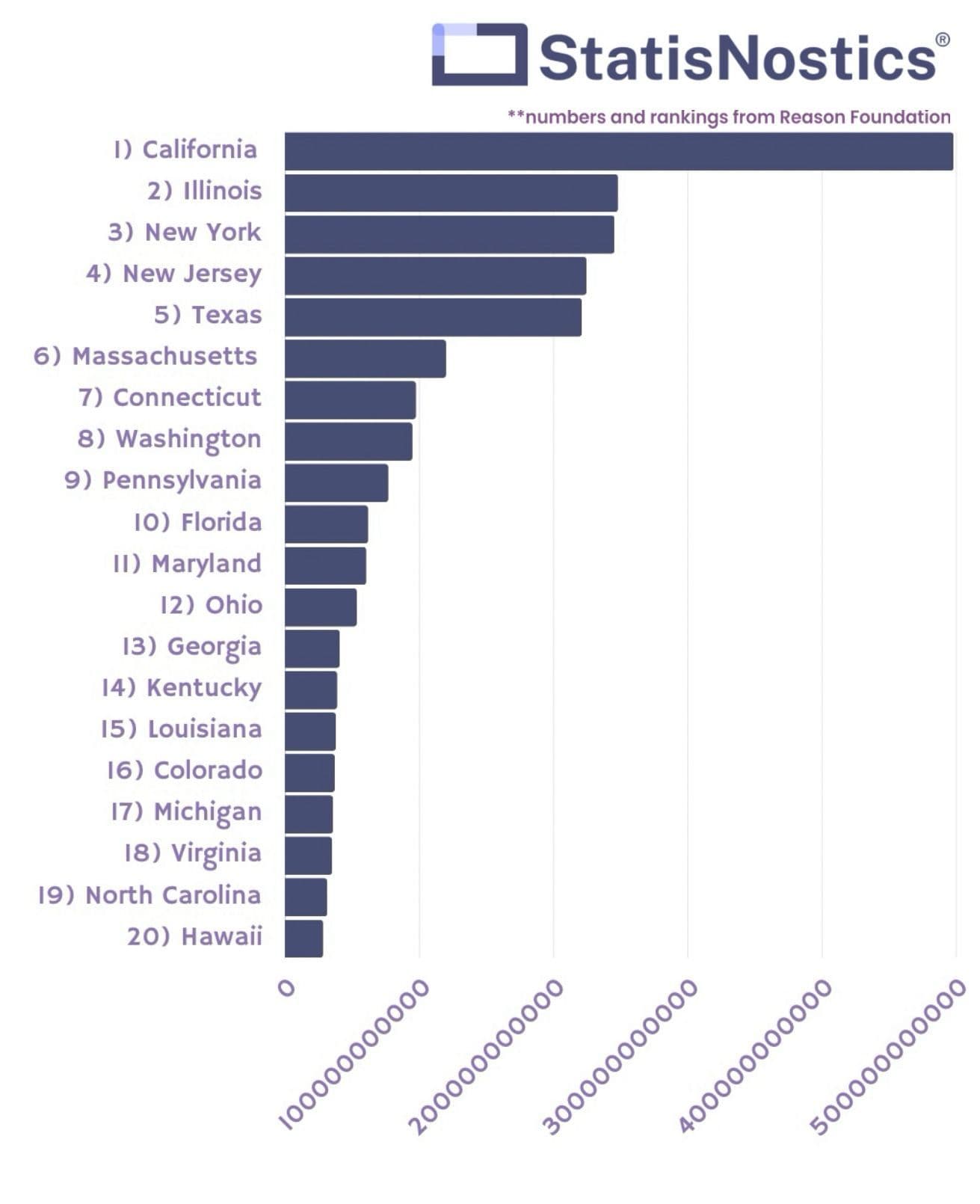
Total Liability Ranking by State, top 20 (x-axis: U.S. Dollars, y-axis: U.S. States)
The amount of liability between states isn’t the only evidence supporting Simon’s theory. The University of Denver’s Daniels College of Business did a report titled “Financial State of the States 2024” under their Truth in Accounting (TIA) initiative. TIA promotes transparency as it pertains to each state’s financial condition. In the 2024 report, TIA gave each state a letter grade based on how well they balanced their budgets (utilizing the Taxpayer Surplus™ and Taxpayer Burden™1). Virginia ranked 13/50 with a Taxpayer Surplus of $4,900 and a final letter grade of B. New York ranked 39/50 with a Taxpayer Burden of $9,700 and a final letter grade of D. What does this mean? Again, New York has accrued more state debt than Virginia— making a greater contribution to the U.S. National Debt.
But is it fair to say that Hamilton and Jefferson’s debt dogmas have seriously had an impact on the landscapes of their home states? Let’s zero in on their hometowns to see if the trend continues: Monticello (modern-day Charlottesville) and New York City.
According to StatisNostics, a database that utilizes U.S. government census data, NYC does, in fact, have a higher Spending Pressure®2 score along with a significantly higher debt burden than Charlottesville. Looking at the debt and spending index of the two cities, New York also has a greater debt index score than Charlottesville despite the Virginian city having a higher spending index.
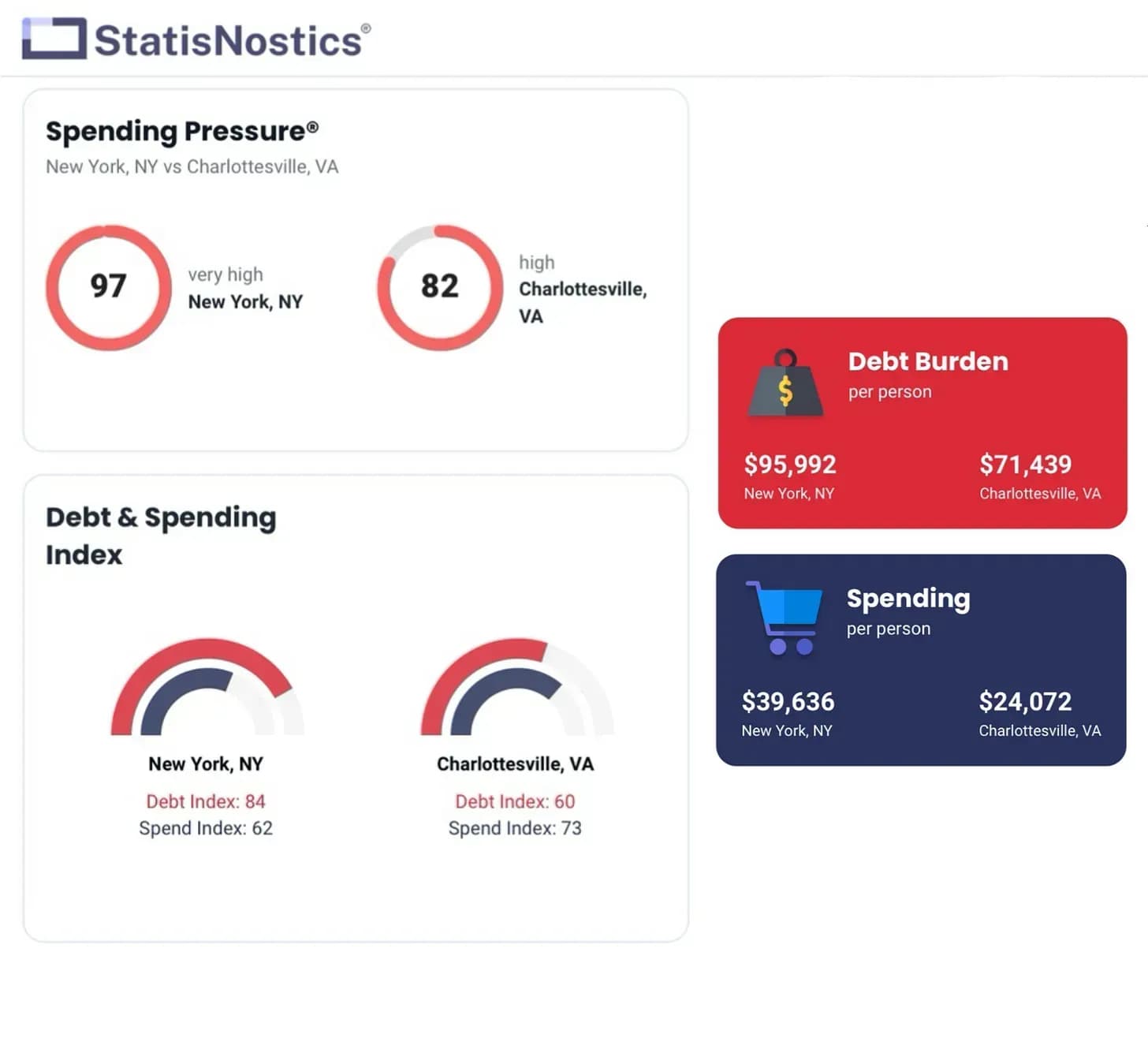
StatisNostics comparison of New York City vs. Charlottesville
Schama believes that “a historian’s task is to breathe life into the past, to make it real and tangible to the present.” Well this week, we’re all historians. We’ve proved in this analysis that Hamilton and Jefferson’s ironclad financial beliefs have influenced the fiscal environments of their respective hometowns. Each of their ideas, passed down through generations, has laid the foundation for the economic state of their regions today. Their memory has shaped their landscape.
1. University of Denver. “Financial State of the States 2024.” Truth in Accounting, www.truthinaccounting.org/library/doclib/Financial-State-of-the-States-2024.pdf. Accessed 5 Jan. 2025.
2. Trujillo. “State Debt: California, Illinois, New York, New Jersey and Texas Each Have over $200 Billion in Total Liabilities.” Reason Foundation, 19 Dec. 2024, reason.org/transparency-project/debt-trends-state-local/state/#:~:text=On%20a%20per%20capita%20basis%2C%20Reason%20Foundation%20finds%20Connecticut’s%20total,per%20capita)%2C%20and%20Wyoming%20(%24.
3. Books, John Ferling / TIME. “Presidents’ Day Special: Thomas Jefferson’s Take on Hamilton.” Time, Time, 15 Feb. 2016, time.com/4210440/jefferson-hamilton-excerpt/.
4. StatisNostics. “Overview Comparison.” StatisNostics, statisnostics.com/overview/compare?address1=1694+Park+Ave%2C+New+York%2C+NY+10035&address2=1050+Monticello+Loop%2C+Charlottesville%2C+VA+22902. Accessed 4 Jan. 2025.
5. “Treasury: $624 Billion Deficit in First Two Months of Fiscal Year 2025.” Committee for a Responsible Federal Budget, www.crfb.org/press-releases/treasury-624-billion-deficit-first-two-months-fiscal-year-2025. Accessed 5 Jan. 2025.
Credit Photo Credit: kridha.net
1. “Taxpayer Burden” and “Taxpayer Surplus” are both terms coined by Truth in Accounting.
2. SpendingPressure® is a term owned by StatisTax, LLC. To learn more about SpendingPressure®, feel free to refer to the article linked here!